



Press Release
The Digital Nation Pakistan Act 2025: The Law That is Redesigning the Way Citizens Deal With the State
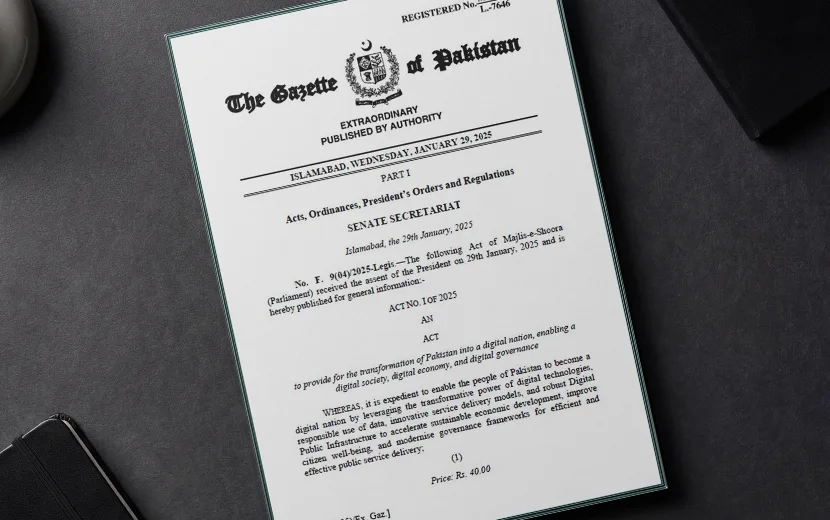
A guide to the law behind the Pakistan Digital Authority
Somewhere in your house there is a photocopy of your CNIC. Probably several.
You keep them because you know how this goes. Whether you want to apply for a license, a loan, or a property transfer, someone will ask for that copy. Plus a form you have filled out a dozen times before, asking for facts the state already has sitting in a file somewhere.
You see the same gap everywhere you look. Services you cannot get online. Subsidies not being able to reach the people they were meant for in time. A record sitting in one department that another department has no way of checking. An economy running on paper while everyone else has moved on.
A law now exists to end that: the Digital Nation Pakistan Act 2025. It was signed on 29 January 2025.
The whole point of the Act is to bring services within reach of every citizen. To make sure support actually lands with the people it is meant for. Let departments check what they need to check, instead of asking you to carry the proof around yourself. And build an economy that is actually ready for a digital future, instead of catching up to one.
What the Digital Nation Pakistan Act 2025 Actually Is
The Digital Nation Pakistan Act 2025 is the federal law that created one body with the legal power to lead, plan and govern Pakistan's digital transformation. That body is the Pakistan Digital Authority, or PDA.
Underneath the legal language, the Act does two jobs. It sets a national direction for going digital. And it builds an institution with the authority to actually get there.
The second job is the one that matters. Plenty of countries have published handsome digital vision documents that led nowhere, because the body meant to deliver them had no real mandate and no staying power.
The national direction for digital transformation has three pillars: a forward-looking digital society, where every citizen can take part; a thriving digital economy that creates value and jobs at scale; and a collaborative digital governance, where the state delivers to people rather than making people chase the state. The Act also focuses on creating a secure, inclusive, and interoperable Digital Public Infrastructure as a key enabler of innovation, connectivity, and seamless integration across sectors.
What the Act Created: the Pakistan Digital Authority
The Pakistan Digital Authority (PDA) was created as a statutory body as a result of this act. The PDA exists in law, with its own legal identity.
In practice, the PDA can sign contracts, hold property and go to court in its own name. That is the line between a good idea and a real institution.
The Act gives the PDA's leadership a five-year term that cannot be renewed. It means the people running the PDA are not angling for another term, and the institution is built to outlast headlines.
PDA's Mandate
Under Section 8 of the Act, the PDA's mandate centres on a few core jobs:
- It builds the National Digital Masterplan, the country's plan for going digital, including sectoral plans and implementation plans, to ensure alignment with the strategic guidelines of the Commission.
- It issues and enforces regulations, guidelines, and standards necessary to implement the Masterplan.
- It develops the digital economy strategy in collaboration with relevant stakeholders.
- It carries out oversight, sets standards, enforces compliance, and establishes any necessary framework and processes in areas assigned by the NDC, including data management and governance, artificial intelligence, virtual assets, and other emerging technologies.
- It ensures the development, adoption, and oversight of the Digital Public Infrastructure, or DPI, which is the shared national plumbing that everything else sits on: digital identity, secure data exchange, and cloud and digital infrastructure.
- It sets and enforces the National Data Strategy and data governance framework, so data can move securely between institutions while each department keeps control and responsibility for its own records.
- It promotes and facilitates digital innovation by recommending policies and establishing frameworks that encourage the responsible use of emerging technologies, fostering innovation ecosystems and supporting research and development as required to advance the objectives of the Masterplan.
- And it owns the citizen experience. This is the one that should matter most to you: the Act makes the PDA answerable for whether public services are actually simple to use, not merely switched on.
That last job is easy to overlook. All sorts of e-government projects look finished on paper and fall apart the moment a real person tries to use them. Here, that is PDA's stated responsibility. Read the entire section on the powers and functions of the PDA here.
How the PDA, the NDC and the Oversight Committee Fit Together
The Act does not hand everything to one body. It splits the work three ways, so nobody grades their own paper.
The National Digital Commission, or NDC, sets the direction. The Prime Minister chairs it, alongside the four provincial chief ministers, senior federal ministers and the heads of bodies like NADRA, the FBR and the State Bank. It signs off the Masterplan.
The Oversight Committee, led by the Minister for Information Technology and Telecommunication, watches the delivery and reports back up to the Commission. It brings together the IT, finance and planning secretaries, an SIFC representative and four independent members from the private sector.
The PDA does the building. It takes the approved direction and turns it into standards, infrastructure and working services.
The cleanest way to say it: the Commission approves, the PDA delivers, and the Oversight Committee keeps a check.
The Difference Between the Act, the PDA and Digital Nation Pakistan
Three names get used as if they mean the same thing. They do not, and it is worth getting straight.
The Digital Nation Pakistan Act is the law. It is the rulebook that says what should happen and who answers for it.
The Pakistan Digital Authority is the body the law built to do the work. If the Act is the blueprint, the PDA is the crew on site, holding the legal tools to turn a drawing into a building.
Digital Nation Pakistan is the goal underneath both: a country where the economy, government and daily services run digitally. The Act is how that goal became law. The PDA is how it gets built. Digital Nation Pakistan is what the whole effort is for.
Why This is Worth Watching Now
Most transformation stories get told after the fact. This one is being told mid-build, which is an odd place to write from. But the shape is familiar. Many countries like Estonia and Singapore did not become digital states on the strength of flashy apps. They laid quiet infrastructure and let everything else grow on top of it.
Pakistan has now given itself the legal ground to try the same. For the first time, the plan has a builder: the PDA. The vision was never the issue, it's the build that counts and that makes this worth your attention.